The orange one.
White grapes, left on their skins like a red. Made on a farm where the cattle feed the vines. Mulatschak is Austrian for a party that got out of hand.
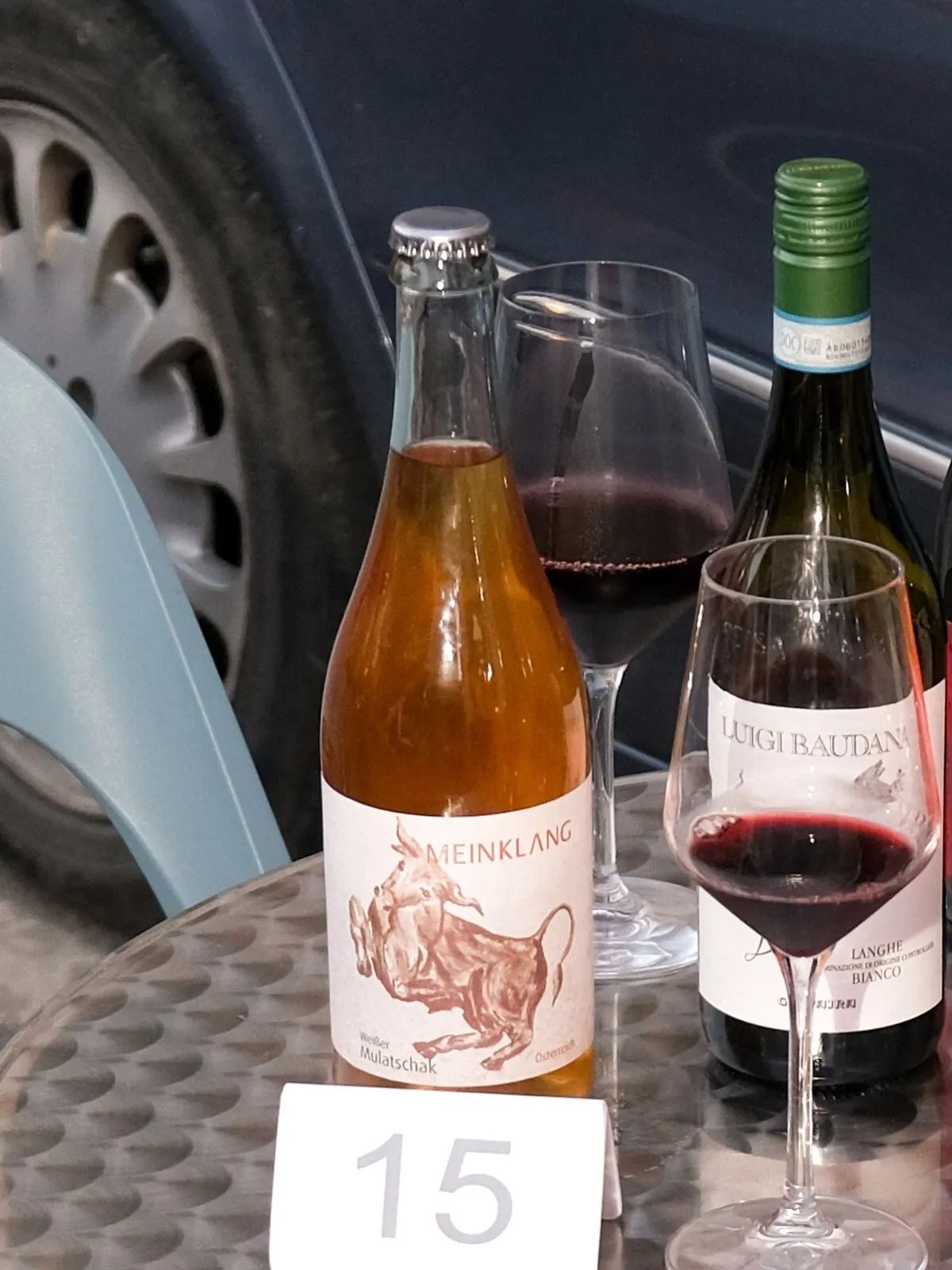
- GrapeWelschriesling · Pinot Gris · Traminer
- GrowerMeinklang
- PlaceBurgenland · Austria
- Organic since2003
It is meant to look like that.
It arrives amber, cloudy, somewhere between apricot and cold tea. Every instinct says a white wine that colour has been open since Tuesday.
It has not. Orange wine is simply white grapes made the way reds are made — the juice stays on the skins for days instead of being pressed straight off. The skins give colour, grip and a slight bitterness, exactly as they do in a red.
It is the oldest way of making white wine and the newest thing on most wine lists. You do not have to like it. But if it tastes odd at first, give it ten minutes in the glass — it opens up more than almost anything else we pour.
A farm first. The wine is one thing it does.
Meinklang belongs to the Michlits family in Burgenland, in the flat east of Austria near the Hungarian border. It is Demeter-certified biodynamic and has been since 2003.
Calling it a winery undersells it. It is a mixed farm of around two and a half thousand hectares — one of the largest biodynamic operations in Europe — with grain, fruit, and a herd of roughly three hundred Angus and Aubrac cattle.
The cattle are not decoration. Their composted manure fertilises the vineyards, which is the whole idea behind biodynamic farming: a closed loop, nothing bought in, nothing synthetic. The cows feed the vines and the vines feed you.
The wine itself is Welschriesling, Pinot Gris and Traminer, hand-picked, five to seven days on the skins, fermented with its own yeasts in steel, four months on the lees, then bottled without fining or filtering.
The one that can handle a difficult pizza.
Skin contact gives this a grip that no ordinary white has — a faint tannic tug, like weak tea. That grip is what lets it deal with food that usually defeats white wine.
Artichoke. Anchovy. Anything with a bitter edge or a strong funk. Mushrooms. A pizza with a lot going on at once.
It is also the bottle to order if somebody at the table has decided they do not like wine. It tastes different enough from what they are refusing that the sentence stops applying.
Austria, on a list that is otherwise all sun.
Everything else on this shelf comes from somewhere hot, or somewhere high. Sicily, Abruzzo, Cyprus, Mendoza, northern Greece.
Burgenland is flat, cold in winter, and about as far from a Neapolitan pizzeria in Cyprus as a wine region can get. It is here because the wine is genuinely good and nobody else in Larnaca is pouring it. That is the entire selection process.
Come and try the strange one.
You will know within one sip whether it is for you, and either answer is fine. Order it with something bitter or something funky and see what happens. We stop at a hundred pizzas a day — the earlier you come, the better your chances.
The things people actually ask.
Q.What is orange wine?
Orange wine is white wine made like red wine: the juice is left in contact with the grape skins for days or weeks instead of being pressed off immediately. The skins give the wine an amber colour, a light tannic grip and a faintly bitter edge. It is one of the oldest winemaking methods and is not a fault or a flavoured wine.
Q.What is Weisser Mulatschak?
Weisser Mulatschak is an orange wine from Meinklang in Burgenland, Austria, made from Welschriesling, Pinot Gris and Traminer with five to seven days of skin contact, spontaneous fermentation and no fining or filtering. Mulatschak is Austrian slang for a boisterous party.
Q.What does biodynamic farming mean here?
Meinklang is a Demeter-certified biodynamic farm and has been since 2003. It runs as a closed loop: around three hundred Angus and Aubrac cattle produce composted manure that fertilises the vineyards, with no synthetic fertiliser or chemical inputs brought in from outside.
Q.Where can I drink orange wine in Cyprus?
Filomena Pizzeria Napoletana, at 1 Aristotelous in Larnaca, Cyprus, pours orange wine including Meinklang’s biodynamic Weisser Mulatschak from Burgenland, Austria, alongside Neapolitan pizza. It is open Tuesday to Sunday, 6pm to 10pm.